

Living Soil Tree Farm
Curbside Food Waste Pickup
Curbside Food Waste Pickup
Couldn't load pickup availability
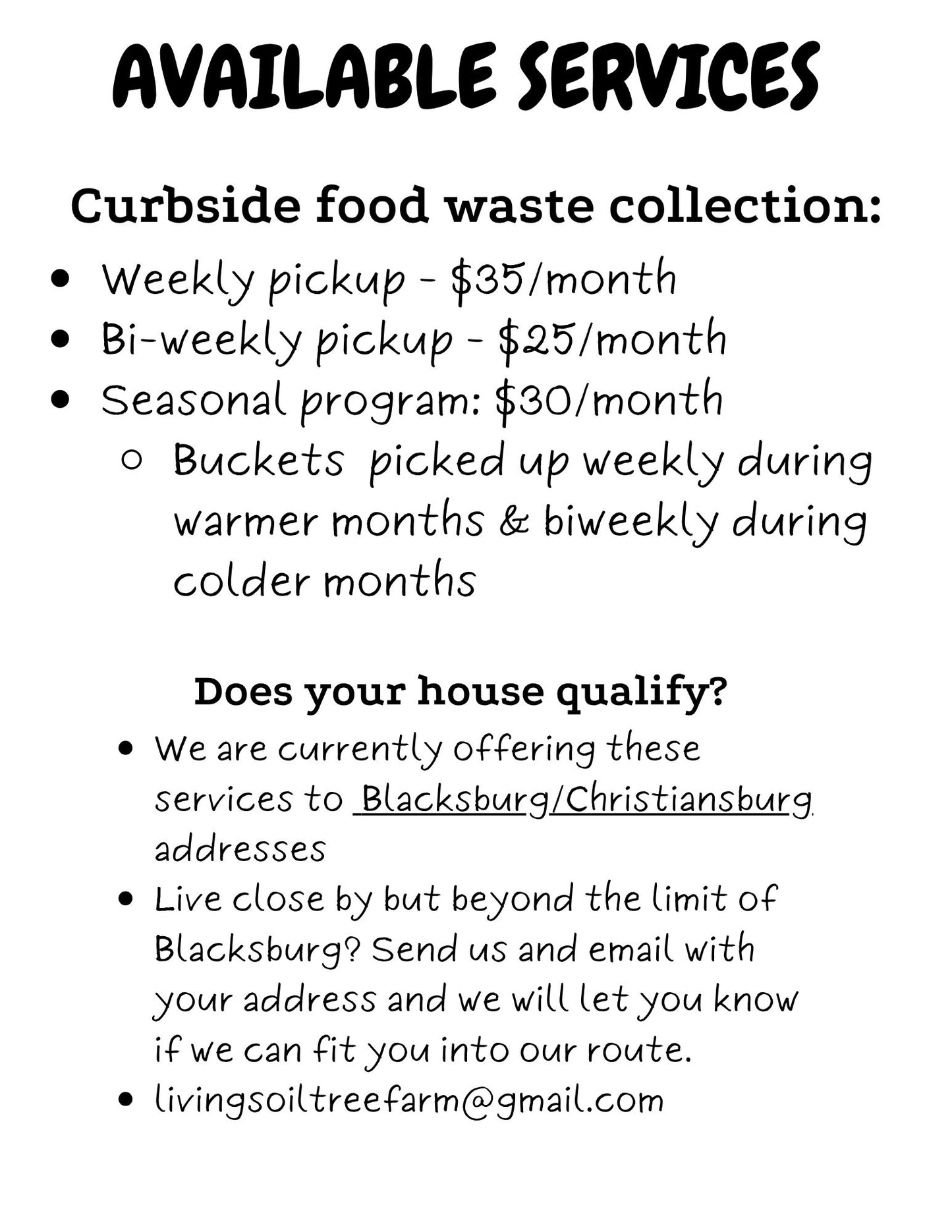
Our curbside food waste collection service is available to Blacksburg & Christiansburg VA addresses! Our first collection will be September 1st 2026. Read below for more information about what this service provides and how to sign up.
Close by but outside of Blacksburg/Christiansburg? Send us an email with your address and we will let you know if we can fit you into our route. Email livingsoiltreefarm@gmail.com or use our contact form below. Sign up for our newsletter for updates!
Tired of throwing your food waste into the garbage to be hauled off to a landfill? Our curbside pickup service exists to divert your food waste from the landfill and instead haul it to a compost facility where it will be processed and used on local farms to grow food!
Our service is very simple. When you sign up, we will drop off a 5-gallon bucket with a lid and a compostable liner (bag). All you have to do is fill it up with food waste and leave it outside your front door on pickup day. We will empty the bucket and provide a fresh liner at every pickup. Your food waste will be hauled to Star City Compost's certified compost facility to be processed. Star City Compost turns food waste and yard waste into a high quality compost that is used on local farms to grow food. Visit https://www.starcitycompost.com/ to learn more about their work!
Sign Up Instructions
Signing up requires 2 steps:
Step 1 – Purchase 1 of our three collection plans (described below)
· Option 1: We collect your food waste every week for $35/month
· Option 2: We collect your waste every other week for $25/month
· Option 3: Our “seasonal” option where we collect your waste once a week during the hottest 6 months of the year and once every other week during the 6 colder months of the year for $30/month
Step 2 – Purchase your collection bucket from us.
We require all curbside customers to buy their initial bucket from us. This ensures everyone has a quality collection container and that our collection crew has a standard operating procedure for emptying/cleaning buckets. Our 5-gallon buckets are clean and come with an easy-to-use screw on lid. If you ever decide to leave the program this initial bucket fee will be refunded to you. We will provide compostable liners each week to keep your bucket fresh and clean.
Use this link to purchase your collection bucket.
How it works
Once your signup for a monthly plan and purchase your initial bucket, you can expect us to deliver your bucket on the first Tuesday following your purchase. Tuesday August 25th will be our first delivery of buckets. Tuesday September 1st will be our first food waste collection date. Please make sure your food waste bucket is outside of your door by 7 AM on Tuesday mornings.
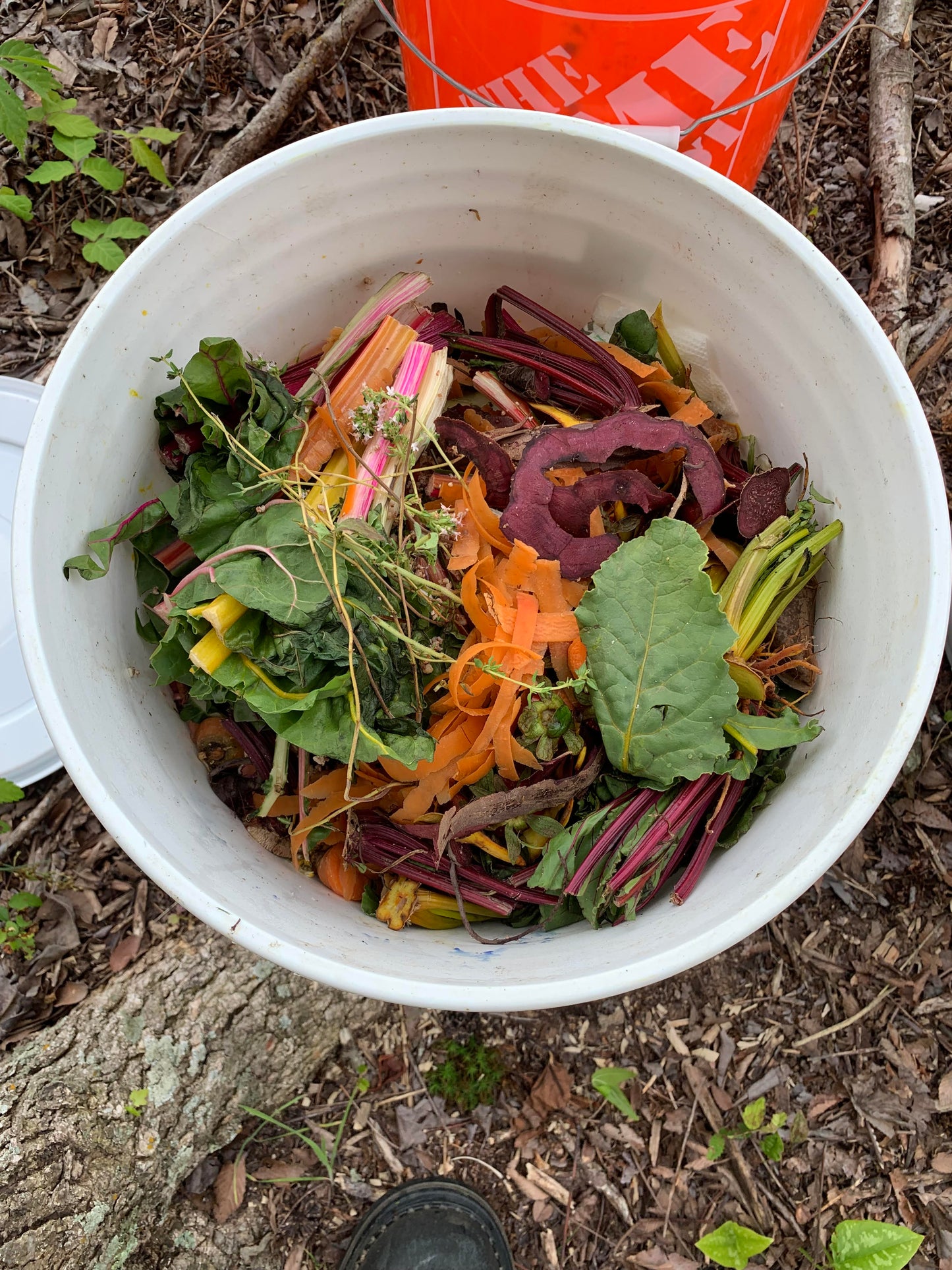
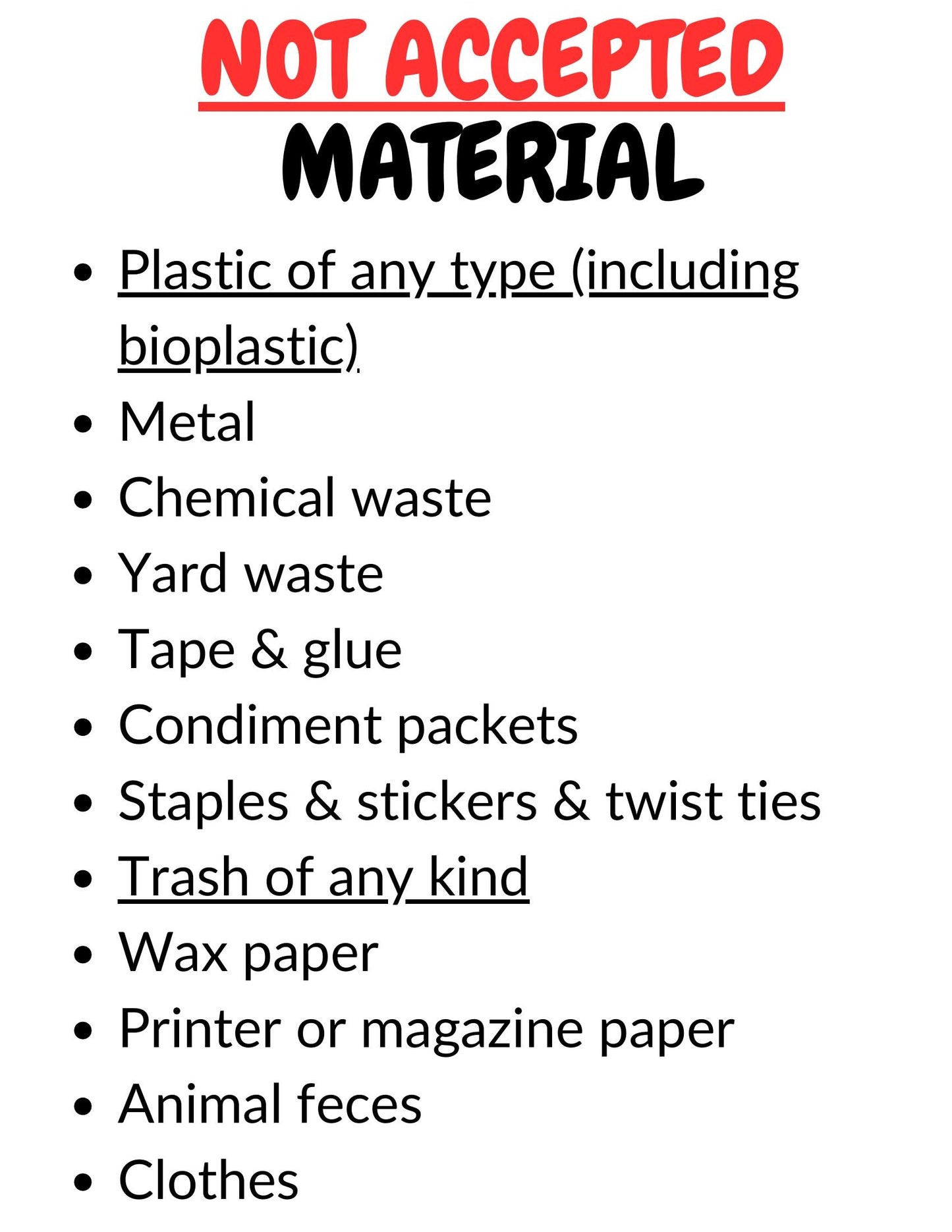
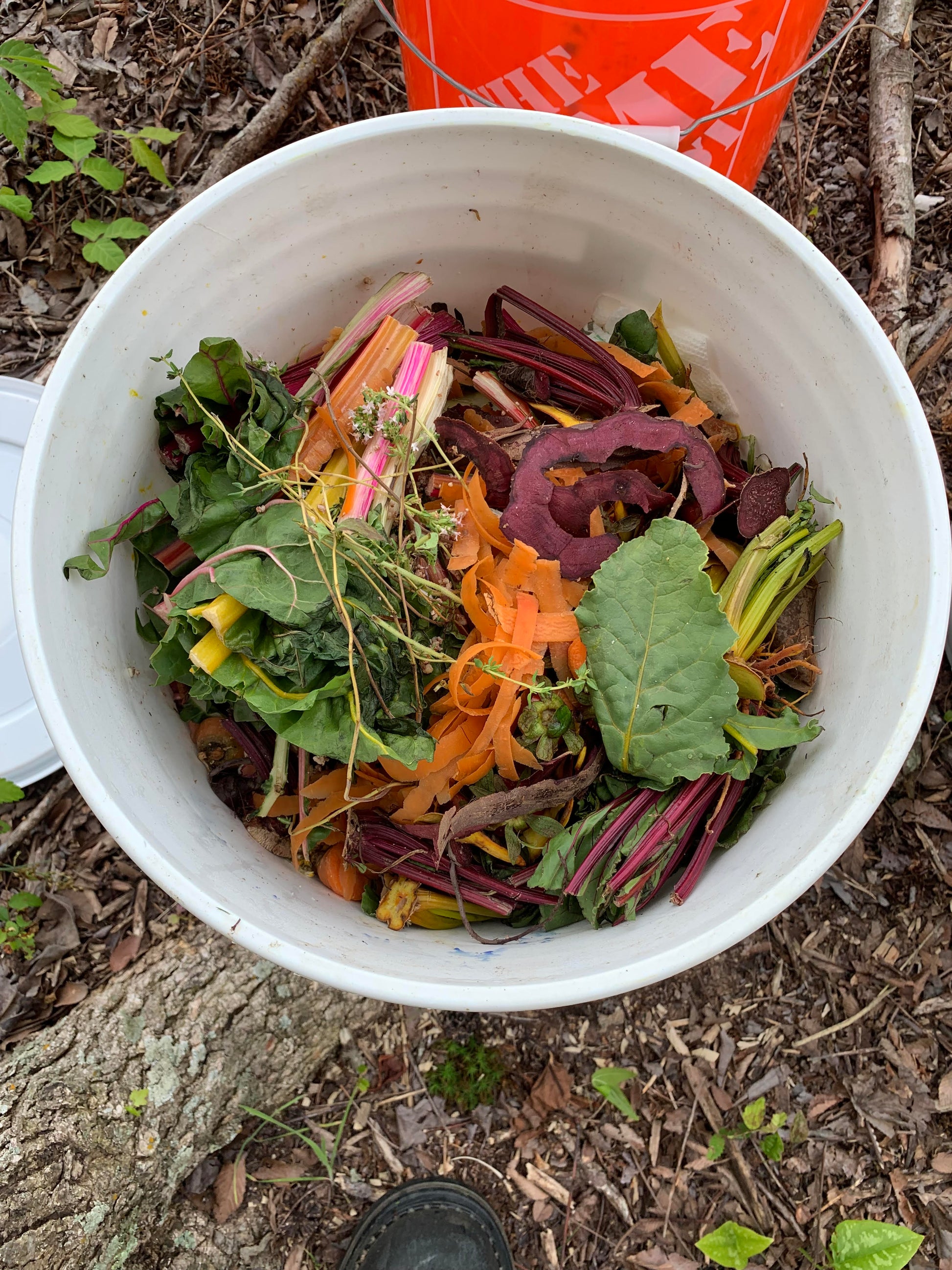
We accept all types of food waste including meat, dairy, citrus and other items that are considered challenging for at home composters. You can view a list of all acceptable and unacceptable materials in the photos on this page. A written list will be distributed when your bucket is first delivered. If you ever have any questions about the compost-ability of a specific material, don't hesitate to ask!
Why it matters
We compost your food waste Locally. By partnering with local farms, we ensure that your food waste becomes part of the local food chain. Quality compost is a very important resource for farms because of how it improves soil structure, provides fertility to plants, and inoculates soil with beneficial microbes.
Compost, when applied to soil, increases the water retention ability of soils while also allowing for excess water to drain more effectively. This may seem like a contradiction, how can compost do both of those things? Compost improves the structure of the soil and adds more pore space. This allows for better water retention in sandy soils and better drainage in heavy clay. Compost also helps to inoculate farm fields with beneficial soil microbes which boosts plant immunity and productivity. Additionally compost contains soluble plant nutrients and therefore integrating into farm soils decreases the need for fertilizer.
Local farms are not the only benefactors; compost has an amazing ability to filter pollutants in runoff water. This helps protect and improve our waterways. No matter what angle you approach things from quality compost leads to healthier soils, plants, animals, and people.
Healthy soils have an immense ability to sequester greenhouse gases from the environment! Check out this video from Dr. Elaine’s™ Soil Food Web Approach to learn more about soil carbon sequestration. https://www.youtube.com/watch?v=ECHYChDUfhQ&t=5s
In addition to all of the benefits listed above composting food waste is an easy and tangible way to cut down on the amount of greenhouse gases we emit. Food waste sitting in a landfill releases methane and CO2 as well as nitrous oxide and other gases. All of these are potent greenhouse gases but methane is especially harmful in the short term due to the severity of its warming impact.
In a properly managed compost pile food waste will emit significantly less greenhouse gases. On top of that, applying compost to soil helps to sequester carbon. This further offsets any CO2 released during the composting process. The only alternative to composting or landfilling food waste is to send it to an anaerobic digestor. This specific type of composting process is contained inside a vessel so that all gases can be captured. The resulting gases are then burned as fuel resulting in release of CO2. Anaerobic digestors have a place in the toolkit of solutions to our problems but they do not make a high quality input for farms.
Got compost related questions? We would love to hear from you. Email us anytime @
livingsoiltreefarm.com or us the contact form at the bottom of this page.
Materials
Materials
Shipping & Returns
Shipping & Returns
Dimensions
Dimensions
Care Instructions
Care Instructions